|
|
|
Ilya
Toshinsky
|
|
|
|
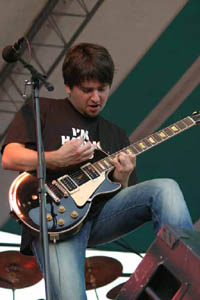
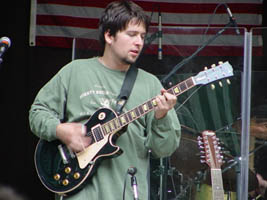
It's
not often that Way Cool Music gets
to talk with a Grammy nominated
artist, but it's nice when the right
cards fall into the place and we're
able to make that happen. For
Ilya Toshinsky, a guitar and banjo
player in the band Bering Strait,
the road to Grammy was a long one,
beginning in Obninsk, Russia. After
being discovered playing bluegrass
music in a Mexican restaurant in
Moscow, Toshinsky and his band mates
made the move to Nashville, Tennessee
in 1998 with hopes of a record deal
and fame. The record deal
came, but then fell apart. In
five years, four labels picked up
the band, but then collapsed before
they could put out a CD. They
then found a home on Universal South,
which led to the Grammy nomination,
a profile on 60 Minutes, even an
appearance in the 2004 Macy's Thanksgiving
Day Parade. Now the future
seems bright. Toshinsky took
time out of his busy schedule
to sit down with us and talk about
the band, his side projects, and
being at home in America.
|
|
|
|
|
WC:
|
Tell
us a little bit about your background.
|
|
|
|
|
Ilya
Toshinsky:
|
Well,
I started out playing classical
music when I was 10 years old back
in Russia. I grew up in a
small town called Obninsk, which
used to be a closed city. It
wasn't even on the map. It
was a scientific center for Russia.
It's just been in the last
12 years that it appeared on the
map. Actually, It's not really
that small. It's about 120,000
or 130,000 people, so now It's a
decent sized town. I was very
fortunate to be born there because
a lot of very intelligent people
are there; scientists and musicians
living in the same town made for
a really nice community. It's
way above an average Russian town.
Now that I look back on it,
I see that I took it for granted.
When you go outside and see
What's out there, you really appreciate
where you're from.
My
parents sent me to music school
and I played classical guitar. I
didn't really want to because I
was bored with it. Then I
heard the 5-string banjo and that,
for very mysterious reasons, had
a huge impact on me. There's
just something about that sound
that captivated me. My guitar
teacher was putting together a test
band and one of the guys was playing
an Earl Scrugg's tune and I was
just floored by the banjo. I
just bugged my teacher. I
said, "Look, the guy who is playing
the banjo is on the way out, going
to college. I need to learn
how to play this!" My passion
for the banjo was there from that moment.
It was my toy. I played
whenever I could. You never
had to tell me to practice or discipline
myself. It was just something
I wanted to do. It was really
wonderful.
|
|
|
|
WC:
|
Did
that translate back to the classical
guitar or did you just focus on
the banjo at that point?
|
|
|
|
|
|
| IT:
|
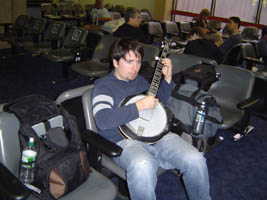
I
did both. Banjo was considered
more like a hobby or fun thing,
where the classical guitar was more
serious. Even after I went
to jazz college 10 years later,
I played banjo as my secondary instrument;
the guitar was the primary. In
Russia, the banjo is a very exotic
thing and It's taken with a grain
of salt. "That's cool, but
you're really a guitar player."
|
|
|
|
|
|
WC:
|
Now
do you consider yourself primarily
a banjo player who also plays guitar
or a guitar player who also plays
banjo?
|
|
|
|
|
IT:
|
It's
both. I feel comfortable playing
both. I love two different
instruments for different reasons.
I can't really say. Guitar
has been much more gratifying as
a musician because I get a lot more
gigs out of it. For writing,
It's very important. But the
banjo has a special place in my
heart. I think I'll do something
cool that hasn't been done on the
banjo, but that's yet to come. I'm
still trying to figure out how to
apply that and do it in a different
way than Bela Fleck has done because
he covers so much ground. So,
I don't want to go that way because
It's his deal, but I want to do
something "new" in the future.
But,
I'm learning how to play the mandolin
right now. I'm getting session
calls for the mandolin.
|
|
|
|
|
WC:
|
People
who can't afford Chris Thile (Nickel
Creek) are looking for you!
|
|
|
|
|
IT:
|
Yeah,
I'm learning to play Chris's stuff.
We used to hang out quite
a bit in Nashville. He's amazing
and a real inspiration. I
was fortunate enough to hang out
with him a lot and just jam and
I'd just watch his hands. Now
that I'm learning to play, I'm trying
to go back to those sessions and
remember and figure it out. To
do what Chris does, you have to
do it full time and it has to be
your priority. His skill is
something that you have to have
when you're young. The precision...It's
amazing.
I'm
just trying to get by. I was
just playing some simple stuff,
and someone liked what they heard.
They called me again, so I
thought I better figure out how
to play it! I just sit around
in my room now learning Chris Thile's
songs.
|
|
|
|
|
WC:
|
What
are your weaknesses as a live performer?
|
|
|
|
|
IT:
|
It's
hard to tell. I don't look
at it that way. It's not like
sports. There's never 'the
best' at music. I don't know.
I don't think about it. I'm
inspired by music. How I feel
about playing live is like Bono
once said, "If I make people
feel half of the excitement that
I feel when I'm playing live, I'm
doing my job." That's how
I look at it. If I'm genuinely
excited by the music and it shows,
then people are going to get into
it and feel that energy. At
that moment, you can make mistakes
and it doesn't really matter. It's
like a zone that you get into and
as long as you're there, you can
do whatever you want.
|
|
|
|
|
WC:
|
So,
we've seen the movie "Ballad of
Bering Strait" and we've heard a
lot of the story behind Bering Strait.
After so much turmoil with
label issues, how did you guys form
the relationship with Universal
South?
|
|
|
|
|
IT:
|
It
all goes back to Tim Dubois. He
used to be the president of Arista
Records and now he's the co-president
of Universal South. He was
the guy who signed us in the first
place and we felt it was important
for us to stick with him and he
wanted to stay in touch with us.
We went to Gaylord with him
and then MCA. And he was our
co-manager for a little bit. Then
when Universal South came about,
it felt like a natural place.
|
|
|
|
|
WC:
|
So
when he calls, do you get nervous
and wonder, "Where are we going
now?!" or are you comfortable with
it?
|
|
|
|
|
IT:
|
I'll
be honest with you, I used to be
nervous about it until three or
four years ago. It was a really
weird time in my life. I crashed
my car and had no money or anything.
It was a point in my life
where I was looking at myself thinking,
"People say I'm good, then why am
I struggling so much?" I decided
to dive into session work and writing
and producing. Ever since,
I've been working on that and found
a way to support myself independently
of what the band is doing. I
never worry about the course of
Bering Strait. I have something
else to fall back on. You
can't get caught up in the label
stuff, especially with a band in
the position we're in where there's
nothing we can do about it anyway.
If you sell millions of records,
then you can have a say so, but
if you're just starting out, you're
at the mercy of the label. That's
the sad truth. You can stress
out or not. You just have
to have good management that will
take care of business. That's
always been my philosophy. Let
the management worry about it and
I'll just show up and do my thing.
|
|
|
|
|
WC:
|
There
are a lot of musicians who have
to fall back on things that aren't
music related, so at least you have
that.
|
|
|
|
|
IT:
|
Exactly.
I didn't have a choice, really,
with our visa situation. We
could only do music to make money,
which was fine with me. I
wouldn't take it any other way.
For some of the others, It's
tougher to get into sessions and
stuff. I think I saw the opportunity
early on. I was in Nashville
and I was in the middle of all of
it. In the beginning, I didn't
think of applying what I do to a
situation where I could make money.
Once I started thinking that
way, opportunities just presented
themselves.
|
|
|
|
|
WC:
|
Bering
Strait started out as a bluegrass
band; why the switch to a primarily
country band?
|
|
|
|
|
|
| 
|
|
IT:
|
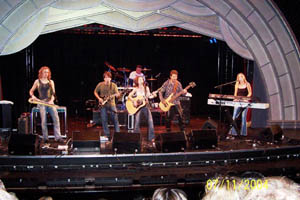
There
were some people in the states who
had visions for the band. Growing
up in Russia, we didn't know the
difference. We started as
a bluegrass band and were a little
country. We started to get
people coming to our shows who helped
us come to America who said, "Bluegrass
is great, but if you want to be
hugely successful, you need to do
country." We were 14 or 15
at the time and so we followed the
advice of those people who told
us to try it. And once we
heard country music, it was new
and exciting and decided, "Why not!"
|
|
|
|
|
|
|
We've
come a long way. Our first
experiences with country music were
pretty horrific. In reality,
you really have to spend time in
America to really get it, especially
the accent. I think for singers,
It's harder to get the drawl. For
instrumentalists, It's easier to
get session work since It's just
your guitar and your amp. That's
your language. You learn the
licks and you're good if you have
a general idea of What's going on.
For singers, It's harder because
there are so many subtleties so
It's a lot harder.
|
|
|
|
|
WC:
|
There's
a trend in country music to play
other people's songs. How
do you as a band, or you personally,
handle the pressure to play other
people's music.
|
|
|
|
|
IT:
|
I
wouldn't call it a trend since It's
always been that way. Country
and pop music seem to be historically
not written by artists. There
are musicians who do their own thing,
but not always. In the early days,
when I got into country music in
the 90s, I realized that there was
a whole army of professional songwriters
who live in Nashville. It's
all they do, is craft songs. The
more I realize, the more I see what
they do, the more I'm amazed by
their craft. I think they
write some great songs! Lyrically,
I think It's easier to write a good
rock song. You can be vague
and vibe-y and not make a lot of
sense, and It's OK. Unless,
you're at the level of Paul Simon.
In country, there are story
songs. It's amazing. When
I write country, I try to team up
with somebody who's an experienced
lyricist and I write the melody
and a lyrical hook and then really
develop it.
It's
always been like that and I think
It's cool. It puts songwriting
on a whole other level. If
It's a great song, you're delivering
a message, and It's helping out
your career. There's nothing
wrong with that! Where a song
comes from doesn't really matter.
If you're a rock artist and
someone wrote a great song (for
you), I think you'd be foolish not
to do it just because you didn't
write it.
In
rock music, bands don't usually
use outside writers. People
aren't into them just because of
a song. It's the whole chemistry.
A lot of the times, the lyrics
don't have to be great story lyrics.
It's about something else.
Country music hasn't been
about fantastic playing, or for
that matter, fantastic singing.
It's about connecting with
the audience through a great song.
When you look at people who
have made it huge, that's what they've
done.
|
|
|
|
|
WC:
|
So
What's the next Bering Strait album
going to be like?
|
|
|
|
|
IT:
|
Acoustic
guitar is going to be a lot more
prominent. Carl Jackson is
doing the record and Carl is a very
talented guy. He's coming
from a bluegrass world, but he's
doing a lot producing in Nashville.
I think the electric guitar
is going to take a supporting role
and the acoustic guitar is really
going to be featured. It will
have great grooves and all that.
|
|
|
|
|
WC:
|
Where
does the banjo fit in?
|
|
|
|
|
IT:
|
Well,
It's been used in some unusual scenarios
where you wouldn't think it would
be expected.
|
|
|
|
| WC:
|
Other
than Bering Strait, what other projects
have you been working on?
|
|

|
|
|
|
| IT:
|
I've
been doing a lot of producing. I
opened a studio in Nashville, Jupiter
Recordings, with two other guys
who are very successful writers.
One of the guys is starting
to produce some acts. Jeremy
Stover is one of the guys. The
other is Brian Mayer. So,
I've been concentrating on getting
with some talented people and getting
them into the studio.
|
|
|
|
|
|
|
I
just finished a project called Stewart
Mayfield Project from Birmingham,
AL. I did the whole record.
Through the Internet, labels
are starting to find them and the
record. The cool thing about
them is that when I met them, they
really sounded like a Dave Matthews
cover band. They're really
talented guys, but the whole style
was Dave Matthews, dead-on! There
were four or five key elements that
were just like them. I talked
to their manager and said, "With
them being so talented, there's
no reason they shouldn't have their
own sound!" The guys started
to respect what I had to say and
I started writing some songs with
them. After a while, we had
three or five songs that didn't
sound anything like Dave Matthews
and it was great. It was different
and exciting and it had a good catchy
sound to it. We went to the
studio and started to record and,
soon enough, we start getting calls
from labels! I'm proud to
say that I helped them along with
their sound. They made a live
DVD that we just finished mixing
and it looks amazing. That's
just another valuable tool. They're
really young and have great potential.
They've gotten better and
better in the past few months.
|
|
|
|
|
WC:
|
And
you've also work with our friend
Eliot (Morris). How did you
guys meet and start working together?
|
|
|
|
|
IT:
|
We
met through a mutual friend. The
way it all started was through the
Pat McGee Band. A long time
ago, Pat was writing with one of
the guys, Mark Selby, from a publishing
company. I was just hanging
out and someone had told Pat that
I play the guitar and banjo. Pat
asked me to play the next day at
some fraternity party. I said,
"Sure!" I was new in town
and it was fun and I ended up playing
with Pat that night. A guy
who was working with Eliot at the
time was in the audience and we
started hanging out and jamming.
He played me a tape of Eliot
singing and I dug his voice. I
asked what he was doing, and he
was in Houston selling real estate!
I said, "No! That's
wrong!" He's such a talented
guy who can do so many things.
I
remember talking to Eliot on the
phone and saying, "Look, you need
to come to Nashville and get into
the studio and do some stuff." So,
that's what he did. I remember
those first few jam sessions we
had. A lot of the songs, like
'Infancy of Us' and 'No One Has to
Know,' were written in those sessions
in his living room. That was
three or four years ago. That
was the first time I went into the
studio wearing the producer's hat,
with Eliot and Chris (Seaver). We
dove into the recording process
and did the best we could. And
It's those songs that got him the
attention from Gary Gersh (Strummer
Recordings). He ended up with
Gary and It's great. He's
just a good guy and a good friend
of mine, so I'm very proud that,
finally, after a few false starts,
that he's in a place where he's
really happy.
|
|
|
|
|
WC:
|
Did
you get a chance to co-write on
any of the new stuff?
|
|
|
|
|
IT:
|
Yeah,
we wrote a lot of songs over the
years. I think he said that
they cut four songs that I'm a writer
on, so It's turned out really well.
|
|
|
|
|
WC:
|
You've
also appeared on a lot of other
albums. How did those experiences
come about?
|
|
|
|
|
IT:
|
It's
part of living in Nashville. It's
a small community where everyone
knows everybody. You never
know who's going to be in the audience
and what they might ask you to play
on their next record. Some
of the sessions I got from word
of mouth and people being in the
audience. You could be playing
the smallest gig somewhere and if
you're really into it and doing
the best you can, someone may notice.
Maybe I'm playing some odd
gig, and It's not my stuff, but
I'm still thinking, "Man, I'm from
Russia. And now I'm in America
playing music and making money at
it!" That's incredible and
warms me up a lot. When you
look at it, a lot of being happy
comes from putting things into perspective.
You can have everything in
the world and be unhappy. But,
if I look back and think about getting
up early and getting on that train
to Moscow and playing jazz, and
now here I am, playing music here.
That makes me happy.
|
|
|
|
|
|
| 
|
|
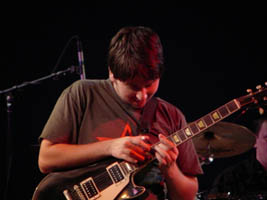
Session
work is really, really fun. There
are certain musicians in Nashville
who I consider Michael Jordan's
of music. Some of the best
people in the world live there.
I'm fortunate enough to be
a neighbor to one of them. Eddie
Bayers, who is a legendary session
drummer. We've become really
good friends. When I was looking
for a house, he advised me on a
place right next to his place and
now I have a great neighbor. Money
can't buy that.
|
|
|
|
|
|
WC:
|
So
was the first question, "Does it
have a sound-proofed room?"
|
|
|
|
|
IT:
|
Oddly
enough, I don't really play at my
house. I do so much during
the day, the last thing I want to
do when I get home is play. My
day is always music, which is why
I don't have the studio at my house.
I need a place to get away
from it because It's such a big
part of me that sometimes I have
to stop to keep it fresh.
|
|
|
|
|
WC:
|
What
do you like to do on your off times?
|
|
|
|
|
IT:
|
I
like watching sports and ESPN. It's
so mindless for me. It's such
a change and all the people are
so excited about the game. It's
pretty contagious. It's a
comfort zone for me. It's
like watching Good Morning America
with a good cup of coffee. I
like basketball and football. And
I liked watching the Olympics. It
made me feel worldly. I like
the Lakers. I don't watch
a lot of sports, but I catch it
when I can. I see those guys
and think about all the money they
make, millions of dollars, and I
think, "I've got to go to work!"
|
|
|
|
|
WC:
|
It's
so interesting that so many musicians
admire sports stars and so many
sports stars admire musicians.
|
|
|
|
|
IT:
|
I
think there is a correlation. If
you're great at what you do, there's
a sort of respect and appreciation
that develops. It doesn't
have to be sports or music; it can
be a mechanic. If he's great
and has a passion for what he does,
It's an art. You can watch
him and get a great pleasure from
it. Anybody who has a passion
for what they do is fascinating.
At a certain level, it all
comes from the same place. But
with sports, It's so exciting to
watch them play!
|
|
|
|
|
WC:
|
You
play a lot of different roles musically
including producer, writing, and
musician. Which of those roles
do you like the best?
|
|
|
|
|
IT:
|
I
really like them all. True
happiness is finding the right balance.
If I've been on the road and
played so much, being a producer
is wonderful. If I've been
in the studio for two months, I
cherish being on the road. It's
all fun for different reasons.
Sessions
are great. What I love about
sessions is that when you're in
a situation with truly great players,
It's amazing. You're just
there for the day, you improvise
for that time, and you don't have
to take it home. You don't
worry about anything when you're
done. There's something about
that that's really cool. Sometimes
your best stuff comes out that way,
when It's not your project. You
go there with a lighter attitude
because you're not stressing out
about it. Sometimes I found
myself coming up with stuff that's
really good because I'm not thinking
about it. A lot of times great
musicians around you will inspire
you to play great things. I've
played on several great country
records like Chris Cagle and Kenny
Rogers and some other people and
that's what happens when you're
around people like that.
|
|
|
|
|
WC:
|
So,
What's been your greatest rock star
moment so far?
|
|
|
|
IT:
|
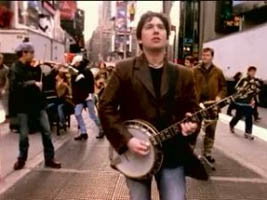
Probably
being on 60 Minutes. That
was pretty good. And getting
the Grammy nomination and being
interviewed by the Russian press,
because it was huge in Russia for
a while. It was cool. They
did an interview with us before
the Grammy Awards and showed it
live on Russian television. It
was great. We felt like national
heroes. For them it was a
huge deal and I felt pretty important.
I've
never been that close to so many
legends. Simon and Garfunkel
opened the show and James Taylor
was there; Coldplay blew me away.
They played 'Politic' and
I just remember that feeling of
the music moving through the air
and the audience was just still.
I remember seeing that stage
and the giant speakers and it sounded
so pristine. I just got goose bumps.
|
|
|
|
|
|
|
|
WC:
|
That's
nice to hear. They focus on
such huge stars and they seem to
be there just to promote their new
CD or just be seen, rather than
to actually experience the night.
How did the Grammy nomination
affect you professionally as well
as personally?
|
|
|
|
|
IT:
|
It
didn't really affect me personally.
I never really dwelled on
it. Professionally, Bering
Strait, for the rest of their lives,
can say, "Grammy nominated" and
use it as a promotional tool. If
people hear that they may think
we're good. So it helps if
we want it to. That's about
it.
|
|
|
|
|
WC:
|
Does
it make a difference to you that
it was a song you guys created versus
someone else's song?
|
|
|
|
|
IT:
|
Yea,
of course it does. But, that's
in the past. It's done and
I've moved on to other things. I
don't sit there and derive pleasure
thinking about the nomination. It's
all about living in the moment.
|
|
|
|
|
WC:
|
Other
than your family, what do you really
miss about Russia?
|
|
|
|
|
IT:
|
I
miss certain people. They
were really a big part of my life
and helped me be the person that
I am through their advice. But
beyond that, I love my life in America.
In a way, I feel more at home
here because my independence is
in America. I'll never lose
the connection with Russia, though.
Being away helps me appreciate
certain things about it. It's
an amazing culture that I'm just
starting to realize. When
I was in school, I was forced into
studying it and that killed the
vibe to really discover things.
But, I've been away for a
long time now and I'm looking forward
to reading more about the history.
Russia is going through so
many things right now and It's really
exciting how It's changing right
in front of our eyes.
|
|
|
|
|
WC:
|
Had
you stayed in Russia, where do you
think your musical career would
be at this point?
|
|
|
|
|
|
| 
|
|
IT:
|
It's
hard to say. I don't think
I'd be playing music for a living.
But, things have changed so
much in the past five years there
that I couldn't even tell you what
It's like. I'm not the best
person to speak about life in Russia
because I'm not there and don't
know what the reality of being there
is. I go there maybe two weeks
out of the year to be with my family.
Back
in the day, in the early 90's, I'd
say playing bars and restaurants
would be the highest we'd go for
playing country and bluegrass. If
you were playing rock, you could
make it. Not to the extent
you can do it in America because
the music business isn't as established
there. People don't make a
lot of money, so It's hard. If
you're in Moscow or St. Petersburg,
people can afford to buy a CD for
$15. If you go outside of
those cities, It's like a whole
other universe and the people are
really poor.
|
|
|
|
|
|
WC:
|
Do
you have any sense of what your
success has given young musicians
in Russia who have heard of Bering
Strait?
|
|
|
|
|
IT:
|
I
don't know. It's kinda soon
to tell. I think people know
the name, Bering Strait, and they
know our story, but they probably
don't know the music yet. Our
label couldn't get the records out
on time when we were really hot,
so the momentum is now gone. You
can buy the CD in Russia, but the
main outlets to buy the records
weren't there at the time.
|
|
|
|
|
WC:
|
Where
do you see yourself in five years?
|
|
|
|
|
IT:
|
Just
making music that's relevant and
I'd like to experience mainstream
success, whether It's as producing
or writing or performing.
|
|
|
|
|
WC:
|
And
do you think Bering Strait appeals
to the mainstream?
|
|
|
|
|
IT:
|
I
think it could. All it takes
is a song, especially in country
music. We can be great instrumentalists,
and that's good for our live show,
but to get into the mainstream in
a country format, you have to have
THE song.
|
|
|
|
|
WC:
|
What
has your audience base been like?
Have you noticed it growing
over the past couple of years?
|
|
|
|
|
IT:
|
It's
really wild, but after the 60 Minutes
show, our audience has primarily
been the more educated crowd. I
love how America has a word for
everything. If you get a bad,
cheap car, It's called a 'Value
car' and you can get a 'Value meal.'
So, we get the educated crowd,
which is primarily over 50 years
old. Don't get me wrong, It's
great. I'm grateful for any
audience. They come to the
show, they buy tickets, and CDs.
Bering Strait would like to
get more young people out to shows,
though. That's kinda been
the marketing strategy. We
played Merle Fest and we're playing
colleges and we'll see how that
goes.
|
|
|
|
|
WC:
|
What
music are you currently listening
to?
|
|
|
|
|
IT:
|
Audioslave.
I really like them. I
love Bela Fleck and the Flecktones.
I go through these stages
when I've had enough, but I'm starting
to go back to them and listen again.
U2 always. I'm a huge
fan. They're always relevant.
It's amazing that they are
able to come back time and again.
They're probably my favorite
band for the time being. I
love Zeppelin and the Beatles, but
right now It's U2. They've
been around for 20 years and they're
still putting out records that are
fresh and not stuck in the 80s.
That's very rare.
|
|
|
|
| WC:
|
What's
the one place in the U.S. that you'd
most like to visit but you haven't
gotten to yet?
|
|
|
|
|
|
| IT:
|
I
feel so content in Nashville that
It's hard for me to think of other
places. The place I haven't
spent any time is San Francisco.
That would be pretty cool.
But I don't have a burning
desire to go anywhere. I would
like to go to Vancouver. I
know it isn't the U.S., but they
have a pretty active music scene
that I'd like to check out. I
think what makes a city appealing
to me is if it has a good music
scene. If it has that, I'm
there. And good food.
|
|
|
|
|
|
|

|
|
|
|
|
What's the worst job
you've ever had? I
never had a
real job. But,
back in my school
in Russia, they
had this huge
piece of land
where they'd
make you go
and just do
manual labor
and dig some
ditches and
carry heavy
things and get
in touch with
nature. I
was in my teens
and I hated
that. It
was a farm,
but they didn't
have a lot of
machinery and
so we had to
do it by hand.
Man, I
hated that.
|
|
|
|
|
|
What's your favorite
movie or lyric quote? From
U2's 'Pride.'
They were
talking about
Martin Luther
King, Jr. and
they said, "They
took his life,
but they couldn't
take his pride."
That's
a great lyric.
|
|
|
|
|
|
Who would you want to
star in the movie of your life? Who
would play me?
Brad Pitt
or Tom Cruise
of course.
|
|
|
|
|
|
What's your favorite TV
theme song? I
love the theme
from Conan O'Brien.
It's a
great combination
of jazz but
done in such
a fun way. If
you analyze
the tune, It's
really intricate.
For me,
a guy who has
a jazz education,
I tried to pick
apart the bass
line and melody
and they have
some great stuff
going on. And
at the same
time, It's so
catchy. (Hums
song.) I
love that. I
wish there were
more themes
like that.
|
|
|
|
|
|
If you were a
superhero, what would your name be?
Big
E. Actually,
some friends
called me that.
This guy
that I work
with, he's a
really fun guy.
But, he
thought that
Ilya was spelled
with an "E"
for a long time.
He'd book
me for sessions
and my name
was always misspelled.
He called
me Big E and
I never really
realized why.
Then I
got it and it
sort of stuck.
There
are people who
know me as Big
E. Big
I just doesn't
have the same
ring to it.
|
|
|
|
|
|
What do you want to be
when you grow up? Grow
up? What
do you mean!
No, I
want to play
music for the
rest of my life.
I know
it sounds cheesy,
but I'd like
to devote my
time to bringing
parts of the
world together.
It used
to be the Soviet
Union and the
U.S. that were
so polar opposites.
Now, It's
a whole different
thing. It's
a lot deeper
with the Middle
East. I'd
like to do something,
or I wish someone
would do something,
which would
bring all of
the religious
leaders together
and make them
understand that
we're all human
beings and we
don't need to
have wars over
religion. I
guess my biggest
fear is a religious
war because
on some level,
all the religions
are the same.
Someone
needs to send
out a message
that only a
few people are
causing the
problems and,
for the most
part, everyone
is content with
others. It
would be good
to stop this
circle of hatred.
Kids are
growing up with
hate. I'd
like to do something
with music to
smooth that
out and make
it better.
|
|
|
|
|
|
Finally, why are there
so many songs about rainbows?
Are
there, really?
|
|
|
|
|
| WC:
|
Thanks
so much for taking the time to talk
with us.
|
|
|
|
| IT:
|
Thank
you, that was fun!
|
|
|
|
To find out more information about Ilya
Toshinsky and some of his projects, please
visit
www.beringstraitonline.com,
www.stewartmayfieldproject.com,
and www.eliotmorris.com.
|
|
|
|